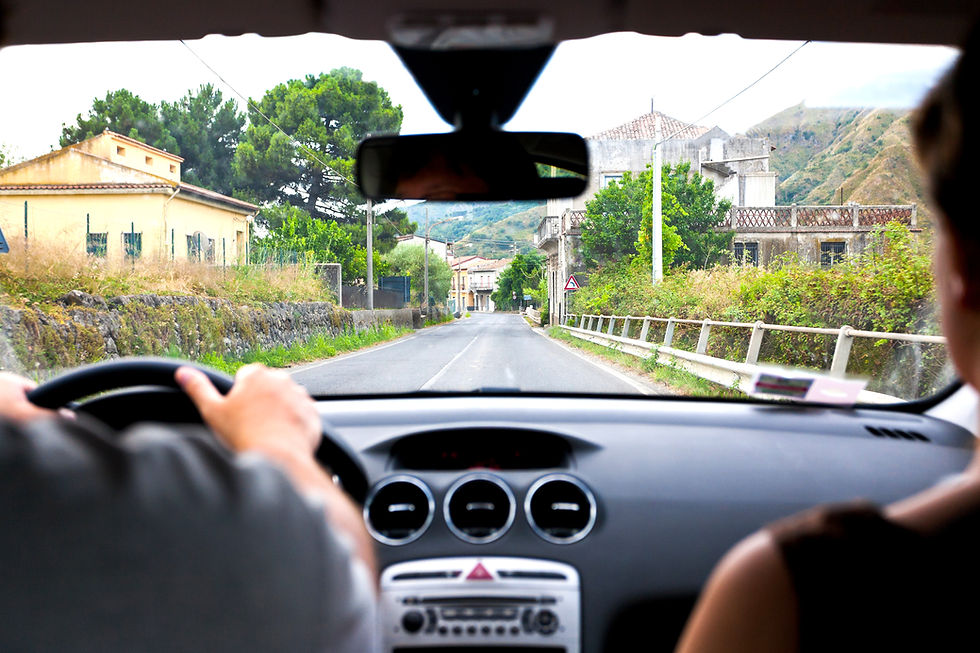
How Yellow Sunglass Lenses Work
Some people love yellow lenses, while others hate them. It confused me for a long time, but I have finally figured out why that is. This is everything about how yellow lenses work and whether they would work for you.

In This Article
How Do Yellow Lenses Work?
The visible light spectrum (the light/colors we can see) is made up of wavelengths of energy that correspond to different colors interpreted by our eyes. The highest energy and shortest wavelengths is the blue light spectrum. Green light has less energy and longer wavelengths, and red light has the lowest energy and longest wavelengths.

You'll notice that yellow is also on the visible spectrum, but we don't actually see it as yellow. Our eyes don't have yellow photoreceptors. When we see the color "yellow," we are actually seeing a combination of green and red. The lightwaves from the yellow part of the spectrum actually muddy the way our eyes perceive green and red and confuse colors. That is why many premium brands have filters to remove this unhelpful section of the spectrum.
This is really astounding, as our brains are perceiving something real that our eyes cannot actually see. Yellow light exists, but the color yellow we see is actually a creation of our minds.
In physics, you cannot mix photons. But in biology, the brain can mix what the eyes pick up. That's how we can see hundreds of shades of color. And that's why you can see yellow even if there is no yellow light present, since a mix of red and green would result in the same yellow perception as yellow light itself. And that is why computer or phone screens only need red, blue, and green lights to make all the colors you are seeing right now, including yellow.
This is important to understand how yellow lenses work.
The principles of how lenses work are as follows:
The color of the base lens tint will let more of the same color light through relative to other colors. A green lens lets more green light in, and a rose lens lets in more red and blue (what primarily combine to make rose).
The color opposite the lens color on the color wheel (the complementary color) will generally be the least transmitted and most muted. A green lens will most block purple (a mix of blue and red), a blue lens will block reds/yellow, etc.

Letting relatively more light of a color through the lens brightens that color relative to other colors. Letting less of that light in relative to other colors will make other colors brighter relative to that color.
Generally speaking, if you want more color contrast (difference in colors), you will use a lens that blocks the most prevalent color in your view and boosts the other colors. If you want less contrast, you will use the lens that is the same as the dominant color in your environment. For example, if you want more contrast on a green golf course, you would use a rose lens. If you want more contrast in a red desert, you might use a green lens.
Yellow lenses are a near equal mix of red and green light, with almost no blue light coming through. You can think of it less as a mix of green/red, and more of the absence of blue light.
Here is how yellow lenses look on some light transmission graphs:

This high transmission lens essentially only blocks blue light. But better yellow lenses will actually cut yellow light as well, which makes the green and red light sharper and results in better clarity:

You can see the lack of blue light and the large dip in the yellow spectrum.
We can also see this by mixing colors in RGB (red, green, blue).

Equal levels of red and green, with no blue, make yellow. Adding blue makes the lens closer to brown, but most brown lenses are more similar to this, with red more prominent than green:

How Yellow Lenses Change the View
Now that we understand what yellow lenses are, we can focus on what they do to the view. And it isn't pretty.
Yellow lenses tend to destroy natural color relationships. Most real-world scenes rely heavily on blue versus green, blue versus gray, and subtle color cues to separate objects and convey depth. When a lens compresses those differences, the scene starts to look muddy and samey, and it becomes harder to visually parse what you’re seeing. Your visual system is very sensitive to those relationships, so losing them feels immediately wrong.

They also interfere with sky/ground separation. The blue sky acts as a large, stable reference plane that helps your brain judge distance and orientation. When that cue is removed or weakened, distances feel off, depth perception suffers, and landscapes appear flatter. This is exactly why trees, buildings, or terrain can blend more into the background when viewed through a yellow lens.
On top of that, yellow lenses create a constant color conflict and exaggerate contrast in the wrong situations. Your brain expects skin tones, foliage, signage, and vehicles to fall within familiar color ranges. Pushing everything "warmer" forces continuous correction, which adds cognitive load (because we are constantly trying to remember what it should look like) and leads to visual fatigue even if sharpness is technically fine. In bright, clear conditions where contrast is already abundant and blue light is not acting like haze, removing blue doesn’t help. It simply removes useful information, which is why yellow lenses often feel harsh or uncomfortable in full sun. It probably won't give a headache, but it can be annoying.
But....
Yellow lenses aren’t useless. In the right environment, they can be a great tool. What they give you isn’t better color or a more natural view. What they give you is spatial contrast. That means helping you see the difference in brightness between objects and settings, rather than the difference between colors.

By cutting most blue light, yellow lenses reduce scatter and visual noise. Blue light has the shortest wavelength, so it scatters the most in the atmosphere. That scatter is what gives haze, fog, snow, and overcast light that washed-out blue-gray look. When you remove it, you’re left with a cleaner signal. Edges defined by light and dark become easier to see, even though the colors themselves are less accurate. Objects can feel more “outlined,” not because they’re sharper, but because there’s less competing noise.
This is where yellow lenses can help with movement detection. Our visual system is extremely sensitive to changes in brightness and edges moving through space. In flat lighting, there often isn’t much useful color information to begin with. Everything is already gray, blue, or low contrast. In those conditions, losing color fidelity doesn’t cost you much. What matters more is separating shapes from their background, and yellow lenses can make that separation feel more obvious.

That’s why yellow lenses make sense in specific scenarios. Driving in rain or snow. Foggy mornings. Skiing or cycling in heavy overcast. Certain shooting sports. These are environments dominated by blue-gray light where blue isn’t carrying helpful information, it’s just adding scatter. In those cases, yellow lenses can make it easier to pick up motion and edges, even if the world looks ugly using them.
They are also boosting spatial contrast where our eyes are most sensitive. Our vision peaks in the green-yellow range (~555 nm). Yellow lenses keep high transmission right around that peak, so even if total light transmission drops, the light that does reach our eyes lands exactly where our vision is strongest.
They don't "brighten things", as that doesn't make sense. Any tinted lens can only block light, not add it. What they do is add contrast, but not the kind we are used to or what most of us enjoy. Our brains equate contrast with brightness. This is a big perceptual trick. Higher contrast equals more separation between light and dark, which makes it feel like a “brighter” scene, even if the average luminance is lower. It’s the same reason black text on white paper looks brighter than gray text on white paper.
The key thing to understand is that yellow lenses aren’t about “better vision” in a general sense. They’re not clearer, more accurate, or more comfortable in most situations. They’re a situational tool that trades natural color relationships for increased luminance contrast. Use them in flat, low-light, low-color environments, and they can be genuinely useful. Use them in bright, clear conditions, and they feel harsh, wrong, and tiring because they’re taking away information your brain actually wants.
That is why most people (myself included) don't like yellow lenses, and most brands do not make premium yellow lenses. But some people really enjoy them. Interestingly, the use case of most premium brands that make yellow lenses is for fishing in low light.
Color tells you what something is. Brightness tells you where the edges and texture are. Yellow lenses reduce some “what” information to improve the “where.”
Now that we understand what yellow lenses do, we can understand why they are so polarizing. Most people enjoy color contrast and enhancement, but some people's eyes and brains work differently. They like spatial contrast more, or at least they like it enough. Why that is, I don't know. Maybe one day someone will do a study about this, and we can get more information.
For now, existing studies I’ve seen have not shown that yellow lenses show any increase in contrast perception.
At the risk of getting too into the weeds, one more point on this. What’s better for detecting movement, color contrast or spatial contrast? Spatial contrast. By a lot.
Movement detection in human vision relies overwhelmingly on changes in brightness over space and time, not on color differences. Motion is picked up mainly by rods (not cones). Those work with light vs dark, not hue. Color vision (red–green, blue–yellow) is slower, has lower temporal resolution, and contributes very little to motion detection.
That’s why you can see something moving in your peripheral vision without knowing its color and notice motion in near darkness where color is mostly gone.
Depth perception is a different story, but this post is getting too long, so that can be for another post.
Sunny Conditions
For most people, yellow lenses are not ideal for bright conditions. Even dark lenses like the Vuarnet Skilynx, in relatively colorless conditions, don't look that good:


This is Vuarnet's own picture, and though it's not exactly how it looks when looking through the lens with your eyes, it isn't far off. And I think it's fairly ugly. They apparently don't think so.
Here's a less extreme example using a simulation in lower light, colorful conditions, using higher transmission yellow, rose, and green lenses. This is a best case scenario for brighter conditions with yellow lenses.


Rose lenses add a lot of color and contrast between different greens, the greens and the sky, and the ball.

A yellow lens makes the blue sky muddy, makes the brighter foreground more stark from the darker background, but overall leaves a sort of sickly view. Useful in a sense, but at the cost of color contrast and aesthetics.

A green lens doesn't have the color contrast of the rose lens, but is much crisper and sharper in terms of color rendering than the yellow lens. This is easier to see with all three side to side, where the yellow lens in the middle is the least visually appealing:
Cloudy Conditions
Cloudy conditions, especially colorless, flat, wintery views, are where yellow lenses can have their place. As discussed above, when the world turns into a low contrast wash of gray, a lot of what you’re seeing is blue weighted light bouncing around in the atmosphere. In that specific situation, filtering some of that blue can reduce the veiling haze and make edges feel a bit cleaner. Texture in snow, tree bark, or uneven terrain can pop slightly more because you’re cutting the scattered light that softens everything.
But that benefit is situational. If the scene already has strong natural contrast, like an overcast summer day, you’re not removing “haze,” you’re removing information. Lighter brown lenses will be better for that.

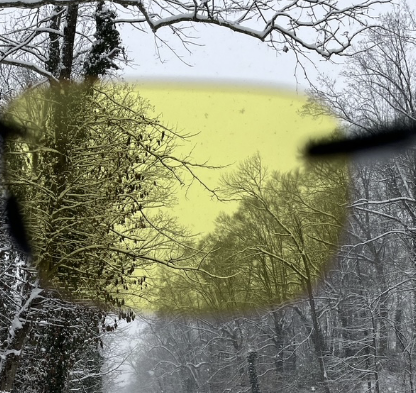
Here is an example:

The yellow view is not nicer, but it is easier to make out the outlines of objects because spatial contrast is increased.

Night Conditions
A lot of people believe yellow lenses are great for night driving because they’ve heard that “they cut glare” and “make things clearer.” There’s a small grain of truth in that. As we discussed, yellow lenses filter out some blue light, and blue light scatters more than other wavelengths. In fog, rain, or haze, that scatter can create visual noise. When you reduce it, the scene can look a little cleaner, and edges can feel slightly more defined.
But at night, your biggest limitation isn’t blue light scatter. It’s the fact that there just isn’t much light to begin with. Human vision in low light depends heavily on overall luminance. Any tint, even a light yellow one, reduces total light reaching your eyes. That means you’re giving up brightness in exchange for a small reduction in scatter that may not even be the main issue in typical night driving conditions.
There’s also the glare misconception. Most nighttime glare from headlights is not something a non-polarized yellow lens meaningfully eliminates. It may slightly soften the perception of harshness because the scene is dimmer overall, but that’s not the same as improving visibility. In many cases, you’re just darkening everything, including pedestrians, road signs, and lane markings, which are exactly the things you need to see.
That’s why I do not recommend yellow lenses for night use, even a high transmission lens.
Top Yellow Lenses
Zeal AutoSun
This is a polarized polycarbonate lens with full backside treatments, the only Zeal non-prescription lens like with all coatings. What makes it stand out is that it changes both tint level and tint color. In lower light, it behaves like a traditional high-transmission yellow at roughly 28% VLT. As UV levels rise, the lens shifts toward brown and drops closer to 15% VLT, which helps with comfort once the sun comes out. Like other UV-driven designs, it will not activate behind a windshield. Here it is activated on the left lens (I covered the right lens with a towel in the sun):

Smith ChromaPop Glass Polarized Low Light Yellow
A mineral glass option with polarization, anti-reflective treatment, and the Smith’s ChromaPop filtering. Light transmission sits at about 33%, putting it squarely in the low-light, high-brightness category (and noticeably brighter than most other options listed here). The glass build focuses on optical precision and scratch resistance while still following Smith’s approach to contrast enhancement. This lens has less "punch" to it compared to some other yellow lenses here, and feels more natural.

Costa Del Mar Sunrise Silver Mirror
I have not tried this lens yet, and can't speak to personal experience with it. This is a yellow base paired with a light silver mirror across the front. The lens is polarized and lands around 25% VLT. Material options depend on the frame you choose (glass or poly), but you can expect Costa’s standard lineup of coatings aimed at managing glare and improving durability.
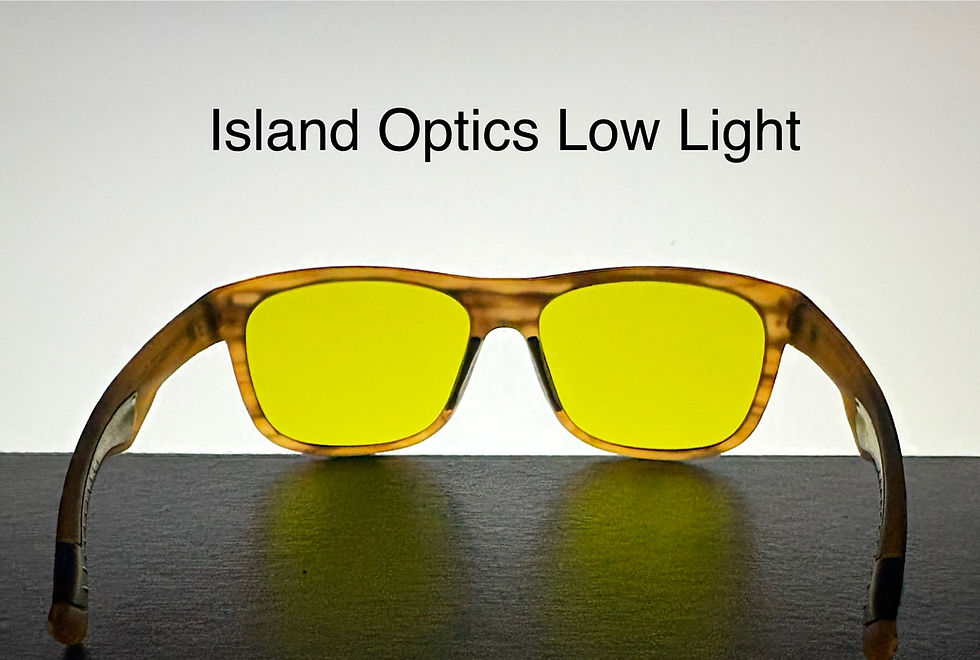
Island Optics Yellow Low Light
This is a polycarbonate, fully coated, silver-mirrored low-light lens with a 24% VLT. The lens feels more saturated and intense than most other options here, and has a more pronounced spatial contrast effect.
Vuarnet Photochromic Yellow Lynx
This mineral glass lens adapts over a very wide range. In very low light, it can be as high as about 65% VLT, then darkens toward roughly 33% VLT as conditions brighten. This used to be the "Nightlynx" lens from Vuarnet, but they changed it to work better in slightly brighter conditions. This is the highest transmission option listed here. The lens has a bi-gradient silver mirror on the front and is fully coated.
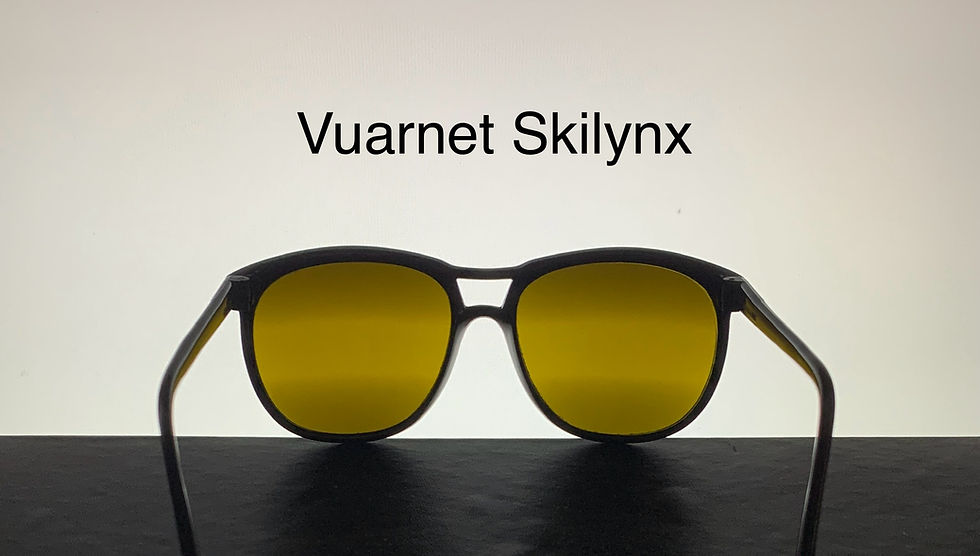
Vuarnet Skilynx
A non-photochromic mineral glass lens with a strong reputation for aggressive filtering in the blue part of the spectrum. The lens has a bi-gradient silver mirror on the front and is fully coated. The lens is traditionally associated with improving contrast in alpine and snowy settings. The VLT is 10%, the darkest option listed here.
Conclusion - How Yellow Sunglass Lenses Work
Yellow lenses aren’t magic. They don’t brighten the world, and they don’t give you “better vision” in a general sense. What they do is remove blue light. That changes the balance of information reaching your eyes.
When you remove blue in flat, low-contrast environments, you reduce scatter and increase spatial contrast. Edges feel more defined. Movement can feel easier to pick up. In snow, fog, or heavy overcast, that tradeoff can make sense.
But in bright, colorful conditions, blue light isn’t just haze. It carries real visual information. Removing it compresses color relationships, flattens depth cues, and forces your brain to constantly recalibrate what it’s seeing. That’s why many people find yellow lenses harsh or unnatural in bright sun.
So the reason people are split on yellow lenses isn’t random. It comes down to environment and preference. If you value natural color and depth, you probably won’t like them. If you care more about luminance contrast in flat light, you might.
Yellow lenses aren’t better or worse. They’re a very specific tool. And like any tool, they only make sense in the right situation.