
Randolph Engineering Cobalt Polarized Sunglasses Lens Review
Updated: Jun 15
Randolph Engineering makes great lenses, and the Cobalt lens is arguably their best, a stunning blue mirror on the glass AGX green lens.
This lens has the exact same tint as the AGX polarized lens. Usually, a blue mirror will make a difference to the tint, blocking blue light and warming the view, but in this case, the mirror has no visible effect when looking through. Because of that, this review is nearly identical to that of the Randolph AGX.
Check out the Cobalt lens from Randolph's website.

If you would like to know how green lenses work in general, click here.
In This Review
Lens Specs | Randolph Cobalt |
|---|---|
Technology | SkyTec™ Glass |
Lens Color | Green |
Mirror Color | Solid Blue |
VLT | Polarized 10%, Non Polar 10% Category 3 |
ABBE | 58 |
Coatings | Anti-reflective, Scratch-resistant, Oleophobic, Hydrophobic, UV, Infrared and Blue-light blocking |
Material | Glass |
Weight | High (relatively) |
Scratch Resistance | High |
Prescription Available | No |
3 |

The clarity of the Cobalt lens is top-notch, thanks to Randolph's high-quality glass lenses.
The lens is equipped with every coating you’d want and then some: anti-reflective, scratch-resistant, oleophobic (oil-repellent), hydrophobic (water-repellent), UV protection, and blue-light blocking. Each of these coatings works together to provide a clean, clear, and durable visual experience.
An interesting feature of Randolph lenses is the infrared (IR) blocking coating, which is not typically found in most premium brands. While most sunglass lenses naturally filter some IR radiation (especially glass lenses), the additional blocking here is worth noting. Unlike UV rays, IR radiation doesn’t cause sunburns or cataracts, as the eye’s natural lens and cornea already filter out much of it. The main potential benefit is reduced heat sensation on your face and around your eyes, which could provide extra comfort in extreme heat environments like deserts, snowfields, or high elevations. For most users, however, the difference is minimal or subtle. Still, it’s one of those "nice-to-have" features with no downside to its inclusion.
Unlike other brands like Serengeti, Maui Jim, and Costa, Randolph doesn’t advertise the use of thinner-than-average glass to reduce weight. While the lenses aren’t especially light, they’re not unusually heavy either. This middle-ground approach keeps the glasses feeling solid but not burdensome during extended wear.
The Cobalt lens does not include color-enhancing technology like some other green lenses. However, for a classic green tint, this isn't a big deal. We will discuss this further in the next sections.
With a visible light transmission (VLT) of 10%, the Cobalt is a darker lens. For context, the classic Ray-Ban G15 has a VLT of 15%, which is 50% brighter than the 10% Cobalt. The Cobalt only came in polarized until February 2026, when it became available in non-polarized as well.
The mirror is not encapsulated in the glass and is prone to scratching more than non-mirrored options from Randolph. Unlike the Atlantic Blue mirror from Randolph (besides that it is a grey-based lens), the Cobalt mirror is highly reflective and maintains a mirror effect through almost all lighting and angles.
I typically avoid discussing frames, since brands often have a wide range of styles, materials, and build quality. That said, Randolph's frames might be made with even more attention to detail than the lenses, which is saying something. While Randolph is not a cheap brand, it's arguably the better choice for those prioritizing both frame and lens quality without compromise.
Is it eligible for prescription?
Yes, go to Randolph themselves or SportRx for all your prescription (and non-prescription) needs. Use code SCIENCE10 at SportRx for $10 off your order.
Also check out: Best Sunglasses Cases, Storage, and Travel Cases.
How does the lens look?
The front has a striking, deep blue mirror, the nicest blue mirror I have ever seen on a sunglass. Usually, blue mirrors have a sporty and casual vibe, often at home at the beach or on the water, but this mirror is classy and dressed up.

The back has a blue shine from the anti-reflective coating. The color is grey/green, relatively closer to the blue side of the spectrum than some other green lenses on the market. The blue mirror has no effect on the lens tint, which is interesting and uncommon.

For comparison, here is the Cobalt and AGX side by side. There is no noticeable difference.
What does the view look like?
Green lenses are generally not considered contrast-enhancing lenses, which are needed for activities like sports. They are used more for relaxing the view, cooling the bright light, and facilitating a more or less neutral view. They are mostly used as an alternative to gray lenses.
Green lenses are great at being a "relaxing" or "soothing" lens, as they can use a high tint to darken the lens more than other tints, but still elicit a feeling of brightness since the green colors are more boosted for our eyes.
The Cobalt is a standard-bearer of that kind of lens, for two reasons. Firstly, as mentioned above, the VLT is a very dark 10%, much darker than most standard lenses.
Secondly, green tints can either be pure green, lean more yellow (which warms up and makes the view more lively), or lean more blue, which the Cobalt does. A bluer green will calm the view down even more, making the sky and water a richer color while taking the edge off of most other objects.
It is a relaxing and soothing tint, while still providing some color-enhancing effects over what a grey lens would have, mostly by boosting greens. For that reason, the Cobalt thrives in full sunlight, where contrast is already strong, and the low VLT can make the view more comfortable without darkening too much.
This lens doesn’t add much contrast or color, but does a good job managing high color and contrast environments. The blue light blocking isn't that noticeable, but it doesn't remove some haze. Since it’s best in very bright light, I would recommend you get these in polarized.
Sunny Conditions
These photos are what Randolph has used to show the view.


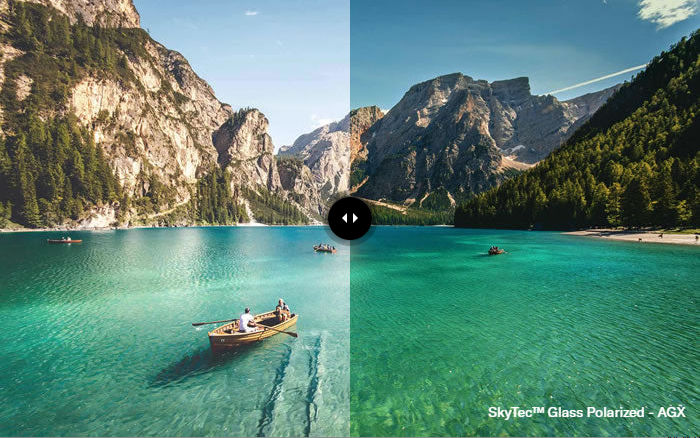
These illustrations are accurate to me, but they are essentially the best-case scenario for this lens. The water is very green, and there are no significant red highlights other than the mountains. Green very much makes this view, and as you can judge from the shadows, we are facing the sun and dealing with heavy direct glare.

This photo is even better. The sun is behind the camera, and it's mixed conditions. Where the sun is bright and the view is green, the lens does an excellent job of highlighting the greens and yellows. However, the area where the shadows are in the distance is darkened to the point of obscurity. Of course, the picture is not perfect and your eyes would have a much easier time adjusting the shadows than the camera, but the point remains that the Coblat does no favors where the sun isn't strong.
Here is my simulation of how the lens looks:

On a bright day when the sun is directly overhead, the intense light can dull colors and reduce contrast, making it difficult to see clearly without squinting.

The view is colorful, comfortable, and still bright. The sky is a lively soft blue, and the greens are glowing. Though it may seem similar to a grey lens, when judging the greens, it becomes apparent that green lenses do alter colors, just not as profoundly as contrast lenses like brown or rose, etc.
A standard grey lens will be similarly comfortable, but with colors neutrally balanced:

Cloudy Conditions
For the reasons listed above, this lens isn’t great in cloudy or mixed conditions. The low VLT, combined with the dulling impact of the bluer green tint, makes the view dark and dull. A gloomy day can become downright depressing.


Optimal and Suboptimal Viewing Conditions
The Cobalt is best for colorful, bright environments when keeping the greens boosted is desired, or for red environments like dry or desert conditions when the reds are too much. Think hot and clear summer. I enjoy this lens driving in the northeast summer in full sun, or in Arizona when I go for work.
I rarely wear this lens in the winter, since there is little green to boost and I want to increase contrast and color, something this lens doesn’t do much of. It works well at the beach, driving, and in any other sunny environment.
If you live in an area that gets lots of clear sunlight year-round, this will work well for you as a daily sunglass, but if much of the year is winter or mixed conditions, you may want to choose another lens in addition to Cobalt.
Sports
I wouldn't recommend this lens for sports unless you live in an area with a lot of sunlight. Even then, a brown or rose lens will provide more color and contrast, which helps with acuity, comfort, vibrancy, and perception. This lens is better for relaxing in beautiful views.
If your sport has any risk of impact to the face, avoid glass lenses entirely.
Comparison to the same brand - Randolph
Randolph American Gray
The American Gray is almost as pure a gray lens as you can find. It is brighter than the Cobalt at 15% VLT, and no colors are boosted. In general, in pure sunlight conditions, I prefer the more comfortable Cobalt, and in mixed conditions, I do not like wearing either green or gray lenses. I choose the Gray when I want a brighter neutral tint in sunny conditions.
See the full American Gray review here.
Randolph American Tan
American Tan is a reddish-brown lens that has a low VLT (11%) while still adding significant contrast. In full sun, it works, though it feels much too hot in comparison to the Cobalt. The Tan performs only average in overcast conditions, thriving in bright haze or mostly sunny with passing clouds. It is a dark lens, often too intense for sunny conditions, and a contrast lens too dark for mixed conditions or overcast.
See the full American Tan review here.
Comparison to Blue Mirror lenses of different brands
Serengeti 555nm Blue
Compared to Serengeti 555 Blue, the Cobalt is a lot more grey/blue and "calm"; putting Serengeti 555 Blue lenses on after wearing the Cobalt feels like someone turned the contrast and color saturation right up. I wear the Cobalt when I want the Randolph look or when I need an even calmer feel than the 555nm Blue provides. The 555nm Blue has all the coatings the Cobalt does.
See here for the full Serengeti 555nm Blue review. Check it out from Serengeti here.
Maui Jim Blue Hawaii
The Maui Jim Blue Hawaii is a grey-based lens with a blue mirror that makes the view slightly more amber. It is arguably the most pleasing lens to wear in bright and colorful conditions and is a great compliment to have with the green Cobalt, as each performs best in bright sun but have different vibes.
See here for the full Maui Jim Blue Hawaii review. Check it out from Maui Jim here.
Conclusion: Randolph Cobalt Lens Review - Should you buy it?
The Cobalt is an excellent lens to look through and at. I wear this lens when I want to wear the iconic Randolph frames with a striking mirror and comfortable view.
For similar frame-centric brands, the focus is more on looking cool than enjoying the view, but with Randolph, they didn't skimp on the lens quality even though the main draw is their fantastic frames. The Cobalt is one of the best blue mirrors aesthetically, and I find myself wearing it more than the AGX just because of the look, though the AGX is my choice when I need to be more dressed up, and mirrored lenses won't work as well.
So, if you are set on buying Randolph, the Cobalt is arguably the best lens you could choose, from both a functional and aesthetic perspective.


