Smith Optics ChromaPop Glass Rose Blue Mirror Sunglasses Lens Review
The ChromaPop Rose Blue Mirror might be the most versatile rose lens, and perhaps the most versatile lens period, ever made. It's photochromic, polarized, glass, and ChromaPop, and it pulls all of that off without feeling busy or overcooked. It works in full summer sun, it works in winter overcast, and it works in a car. Like other lenses I am sure about, you don't need to take my word for it. Try these for yourself and they will sell themselves.
Check out the Rose Blue Mirror lens from Smith Optics here.

If you want to know more about how rose lenses work, click here.
Full Disclosure: Smith provided these lenses for review, but has no input or editorial say in this review.
In This Review
Lens Specs | ChromaPop Glass Polarchromic Rose Blue Mirror |
Technology | ChromaPop |
Lens Color | Rose |
Mirror Color | Blue |
VLT | 12-23% |
ABBE | 58 |
Coatings | AR, hydrophobic, oleophobic |
Material | Glass |
Weight | Moderate |
Scratch Resistance | High |
Prescription Available | No |
1 |
The clarity is what you'd expect from Smith glass, as good as it gets.
The lens is equipped with every coating you’d want: anti-reflective, oleophobic (oil-repellent), hydrophobic (water-repellent), and UV protection (there may be more, but they are not stated; I will update when I ask Smith). Each of these coatings works together to provide a clean, clear, and durable visual experience.
Unlike other brands like Serengeti, Maui Jim, and Costa, Smith doesn’t advertise the use of thinner-than-average glass to reduce weight. While the lenses aren’t especially light, they’re not unusually heavy either. This middle-ground approach keeps the glasses feeling solid but not burdensome during extended wear.
The lens includes ChromaPop technology for color enhancement, which we will discuss in detail in the next sections.

The mirror is not encapsulated, so it can be scratched, though it is still much more scratch-resistant than poly. The good news is the mirror is not a solid sheet of blue, it has that mottled blue-and-red quality from the angle-dependent shift, so the scratches that would show up on a solid mirror are much less noticeable here.
The VLT range is 12-23%, which is a category 2-3 lens depending on where the photochromic sits at the moment. Behind a UV-protective windshield, they will not darken that much. However, that is actually a good thing in general, as the windshield already blocks 10-30% of light, and most dark sunglasses are too dark behind a windshield. A photochromic lens that stays lighter behind the windshield and darkens outside the car is the ideal setup for driving, and that is exactly what this lens does. You can read more about that here.
Is it eligible for prescription?
No. Smith sells Rx directly with poly ChromaPop lenses. SportRx sells it with their own lenses, of which there are many choices. Use code SCIENCE10 for $10 off your purchase at SportRx.
Also check out: Best Sunglasses Cases, Storage, and Travel Cases
How does the lens look?
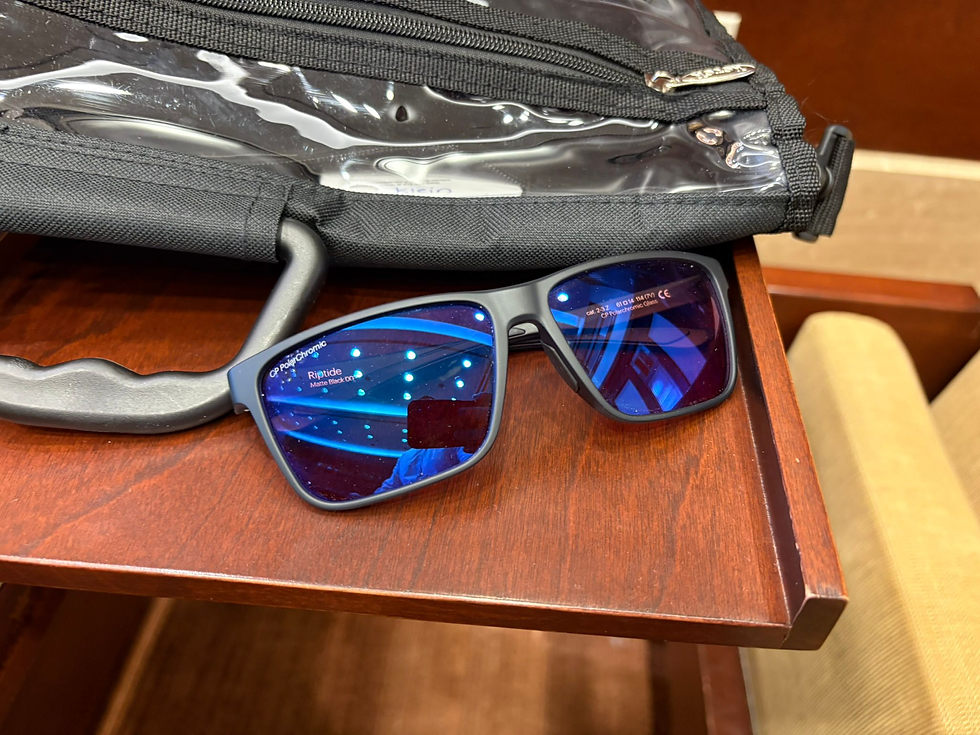
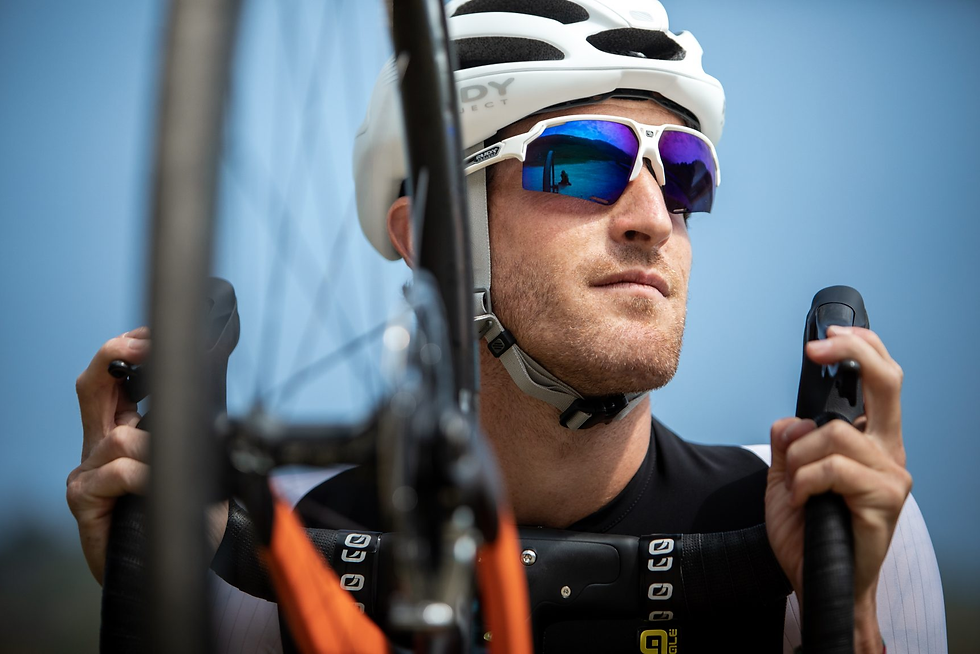
The front mirror is the most polarizing thing about this lens. It is technically a blue mirror but because it is not solid, you get a striking blue-and-red look depending on the angle and lighting. I would prefer it to be a solid blue. This is the only detail about this lens that is really worth considering to be honest. Everything about the lens is just about perfect for most people, but the aesthetic is noticeable in a way some people may not like. Here I am driving with the lens in Los Angeles:

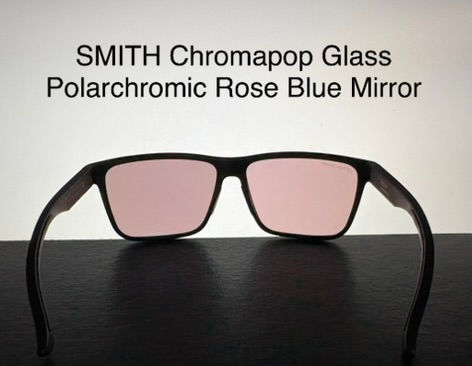
The back AR coating has a blue shine, which is on-brand for the mirror, and the visible tint of the lens is rose. Because it is photochromic, the tint darkens and lightens in real time, so the back appearance changes too. Tint uniformity across the lens is good, I do not see any color shift toward the edges. Here it is with the left lens darkened as I covered the right with a towel (it is around 10% darker):
What does the view look like?
Rose lenses are typically described as a boosted grey with colors highlighted once your eyes and brain adapt. That is roughly true of most rose tints. This one takes it further than any rose I have worn. It does not feel like a rose tint at all, even within seconds of putting them on. The view just feels alive.
Adaptation is basically instant, a few seconds at most. Overall, the view is warm but very balanced, which is unusual for a warm lens. Blues stay natural and even feel a little boosted, greens are normal and full, and reds are natural and brighter. There are no weird color shifts and nothing that looks unnatural.
The lens has ChromaPop technology in it. That means they have used filters or dyes to manipulate the light spectrum to separate and enhance colors. I actually had the privilege of testing some Smith lenses with a visible light spectrometer. What we found is that Smith has heavily reduced the light that between blues and greens, and yellow light that is between greens and reds. This creates a sharper contrast between colors.

The effect is more apparent here than on any other ChromaPop lens I have worn. Colors are highlighted, separated, and natural at the same time. The rose base seems to be the perfect canvas for it.
The best way to think of this lens is like a painter came and put a fresh coat on everything we see. No colors are altered at the expense of others, just boosted pleasantly across the board.
The slightly higher VLT also helps add color. The darker a lens gets the less colors will pop. This lens is the epitome of technologies such as Oakley Prism/ColorBoost/ChromaPop, etc. Other lenses may have a tint you enjoy more, but this lens, with the combination of rose, ChromaPop, and a higher VLT, has the most color pop of any lens I have tried, and it does it in a way that doesn't make the view seem unnatural in any way.
I think nearly everyone is going to like this view. There is no taste split to flag on the optics. The only split is on the aesthetic of the mirror, which I covered above. It is not the darkest lens out there, and if you are light sensitive, you might want something darker, but if you want color and vibrancy, this nails it.
It is nice that polarized + photochromic lenses are finally taking off across the industry. Serengeti has been doing this for decades and was for a long time the only company doing it well. Now Smith, Maui Jim, and Sky Optics are all doing it at a high level, which is great for buyers.
Sunny Conditions
These photos are what I have used to show the view. Keep in mind that photos will never look as good as the real view looking through the sunglasses with your own eyes.
Interested in experiencing this lens for yourself? Check it out from Smith here.
Here is my simulation of how the lens looks:



In bright sun this is an 8 out of 10. The photochromic activates and the lens gets darker but it never quite reaches the comfort of a true 11-12% solid tint. The Smith Glass Green Mirror is essentially this lens locked at 11% VLT, and side by side in full sun the Green Mirror is slightly darker and slightly more comfortable. The rose blue mirror is still very wearable in full sun, just not as effortless as a dedicated bright-sun lens. The grey comparison shot in this section gives you a sense of how a typical neutral lens handles the same scene, and you can see why a boosted rose feels more lively than the flat grey rendering.
If you are light-sensitive, you may want a darker lens for full sun, but most people will enjoy this even in the middle of the day with clear, bright sun.
This lens also works great in the winter, under any conditions you might squint, but again, in the brightest conditions where you need an alpine option that is dark Cat 3 or even Cat 4, these won't do it as well. But for everyday winter, driving or walking, these are fantastic and I spent last winter splitting time between these and the Serengeti Sedona, which I discussed here.


Cloudy Conditions
This is where the lens really stands out. 9 out of 10. The photochromic lightens up to its 23% VLT in overcast, the colors are still highlighted, and nothing feels too dark. There is an added clarity, the colors separate, and it's very comfortable. I was wearing them in this kind of marine thin cloud haze in Los Angeles for a trip there, and they beat out 6 other lenses I had with me:

The view looks like this:



Optimal and Suboptimal Viewing Conditions
Optimal: mixed light, partly cloudy, winter, overcast that is not super dim, sunny days where you want color enhancement rather than maximum darkness. Driving in almost any condition.
Suboptimal: very bright direct sun all day, low light or dusk. This is not a low-light lens. If you are not slightly squinting, you do not want this on your face.
For winter and snow it is a 9, I wore this almost as much as the Serengeti Sedona in the winter, and I actually preferred it in anything less than full sun.
For driving it is amazing and is one of the strongest driving lenses I own. 9 out of 10. The colors are rich, the scene is alert and comfortable, glare is gone.

This is one of the most versatile lenses out there, and one of the most beautiful to look through. If not for the aesthetic, which is a matter of taste, I would recommend everyone get this lens.
(In addition, this lens is only available on a select few frames from Smith, most of which are wrap or activity-focused. The Riptide is the only model I would wear for everyday.)
This lens is very similar to the Dita Lancier Land lens in terms of the tint, versatility, and ability to be used in summer even as a rose lens. The difference is that this is glass, photochromic, and with Chromapop. If you like the Land lens but want glass (or a more rugged frame, or a lower price), you will like this. And if you want this lens with no mirror, the Dita Land lens is your best bet.
Sports
Good for any sport where polarization is not a problem and where impact is not a concern. Golf is great. Hiking, fishing, general outdoor activity, all great. I take my kids to the park in them, play catch on the street, drive around. I trust them in almost any non-contact context.
Comparison to the same brand - Smith Optics
Smith ChromaPop Glass Green Mirror
The closest sibling in the Smith lineup is the ChromaPop Glass Green Mirror at 11% VLT. The Green Mirror is basically the same rose lens locked in its darkest state, with a green mirror on top instead of a blue one. In full sun, the Green Mirror is slightly more comfortable because it stays dark. The tradeoff is that it is too dark in mixed or overcast conditions, and basically unusable on a cloudy day. If you live somewhere with consistent bright sun year round, the Green Mirror is the pick. For everyone else, the rose blue mirror is the more versatile lens.
See here for the full Green Mirror review.
Smith ChromaPop Glass Opal Mirror
The Smith ChromaPop Glass Opal Mirror at 14% VLT is a rose-brown lens that is colorful and vibrant and works well in sun or mixed light. It impacts colors more than the rose blue mirror does, especially blues, though it impacts them less than most brown lenses out there. If you want something that leans warmer and more brown, Opal is great. If you want the most color-true and most versatile view, this lens wins.
See here for the full Opal Mirror review.
Smith ChromaPop Glass Brown Polarized
The Smith ChromaPop Glass Brown Polarized at 12% VLT is a step up in versatility from the Green Mirror because it works better in mixed conditions, but it is not as versatile or as pleasant as the rose blue mirror in my opinion. Worth noting that 12% is the darkest the rose blue mirror gets, so the Brown is functionally similar in bright sun. The Brown does not have a mirror, which some people prefer. It is a saturated red-brown but the chromapop tech keeps colors more balanced than similar brown lenses.
Comparison to Rose Lenses of Different Brands
Serengeti Sedona
The Serengeti Sedona is the most natural comparison and probably the lens this one gets compared to most. The Sedona is a stunning rose lens with a bi-gradient silver mirror, polarized and photochromic, but the photochromic range is narrower at 10-16% VLT. The Sedona is more pink and more saturated, this lens is slightly more purple and less saturated. Here is the interesting part. Because the Sedona's range is tight, it barely shifts between dark and light, and behind a windshield it sits at 16% VLT. Combined with the windshield's own tint that makes the Sedona basically perfect for sunny winter driving. The Smith is the inverse. Its range is 12-23%, so in a car it is much brighter, which makes it better for overcast and mixed conditions. The Sedona still holds its own in overcast because the color enhancement and clarity are usually worth the slight darkness, but it is a tradeoff. I have been favoring the Smith whenever the sky is anything other than fully clear. In bright sun the Smith does feel a bit bright, but I do not mind it much because the windshield handles some of that for me. If you mostly wear sunglasses in the winter on sunny days, the Sedona is the way to go. If you wear shades all the time to cut haze, snow reflections, and car glare, and add clarity, the Smith is hard to beat.
See here for the full Sedona review.
Maui Jim MauiRose
The Maui Jim MauiRose is darker, more saturated, and more red than the Smith. It also has a bi-gradient silver mirror, comes in glass, MauiRose, or MauiBrilliant material, and is the better pick in very bright sun. It is less balanced across colors than the Smith though, the red bias is more obvious. If you specifically want a saturated red-leaning rose, MauiRose. If you want a balanced, natural color rendering, take the Smith.
See here for the full MauiRose review.
Dita Lancier Land
The Dita Lancier Land is the lens this Smith reminds me of most in terms of the actual view. The tint profile is very similar and the way colors render is very close. The differences are physical. The Lancier is nylon, so much lighter than glass. It has no mirror, so the aesthetic is totally different. And the tint does not adjust, so it is slightly darker than the Smith in full sun and noticeably darker in overcast. If you want the rose tint experience without glass weight or a mirror, the Lancier is the choice. The Lancier got into Tier 1 on the strength of its tint alone, even being nylon, which tells you how good that view is, and the Smith pulls off basically the same view in glass with photochromic on top.
See here for the full Land lens review.
Conclusion - Smith ChromaPop Rose Blue Mirror Lens Review - Should you buy it?
This is one of the highest quality, most versatile rose lenses ever made. The tint is balanced, the colors are highlighted without going cartoonish, the photochromic range is wide enough to actually matter, it is glass, it is polarized, and it has the ChromaPop separation working in its favor. It earns Tier 1.
If you spend most of your time in extreme bright sun the Green Mirror or a darker fixed-tint lens will be more comfortable. If the blue-and-red mirror look is not for you, that is a real reason to choose differently.
But for anyone who wants one rose lens, or one lens period, to do almost everything, this is the one. Mixed conditions, winter, summer, driving, hiking, golf, fishing. If you only care about the view and not the front aesthetic, this is genuinely one of the best lenses out there, period. I have been wearing this for months across full summer in Orlando and full winter at home shoveling snow, and I keep reaching for it. I own almost every Smith lens and if I had to pick one to keep this would be it. I am considering buying a second pair to live in my car.